

Volunteer Spotlight: Wes Blackman
A Place Worth Noticing
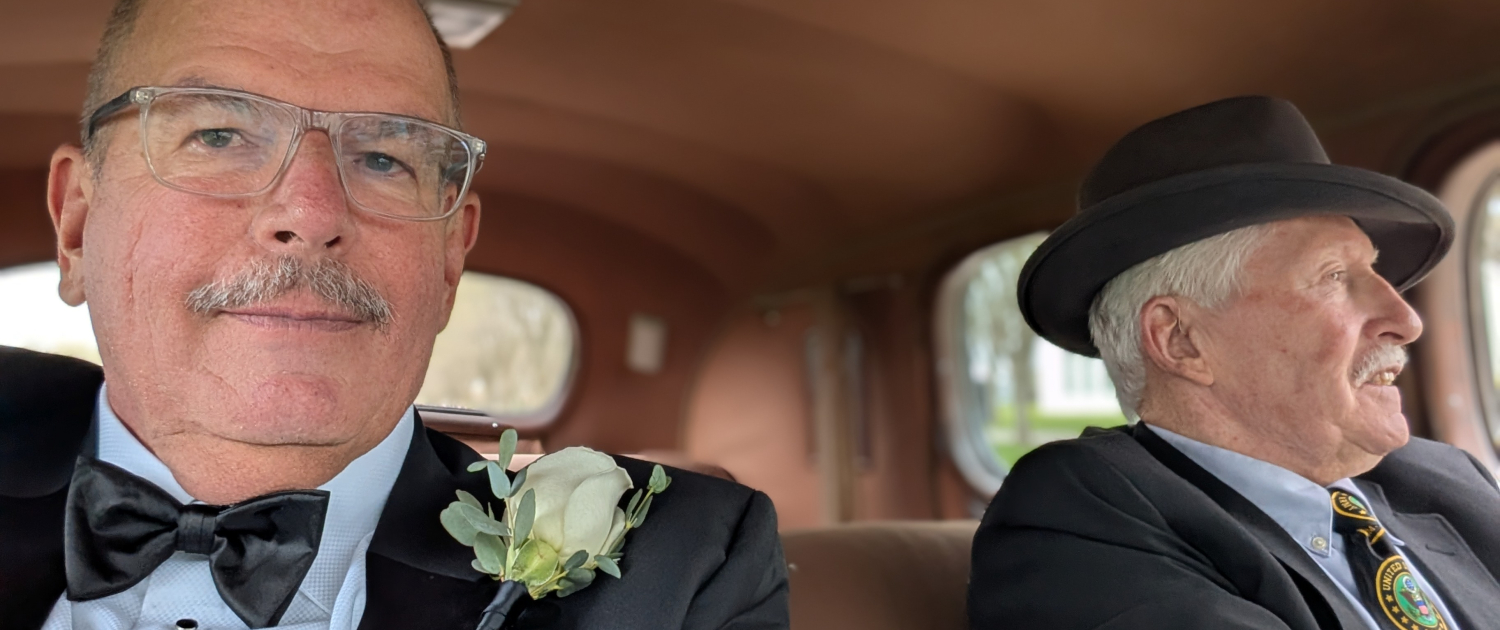
Wes, pictured left, had the opportunity to ride in the very Packard his father had donated to the PMCF, during the 2026 Great Gatsby Gala.
Wes Blackman has been watching the Packard Proving Grounds change for more than fifty years.
His memories stretch back to 1973, when he attended the National Packard Meet in Detroit with his father. The original test track was still intact, and Wes remembers driving around it, attending Carnival of Cars events on the property, and looking south from the grounds toward what was then largely cornfields.
A lot has changed since then. What hasn’t changed is Wes’s appreciation for this particular place.
The Apple Doesn’t Fall Far from the Tree
Packard was an interest he shared closely with his father, an automobile enthusiast and historian of the marque who would become one of the founding members of the Packard Motor Car Foundation. Wes remembers his father’s involvement in those early years – helping facilitate vehicle transactions and donations and doing his part to nurture the fledgling organization.
“The apple doesn’t fall far from the tree,” Wes said. Their shared interest in the automobile hobby, he explained, was something that strengthened the bond between them. After his father’s passing in 2023, Wes joined the Foundation’s Board of Trustees himself, in part to carry that legacy forward.
But the perspective Wes brings to the Proving Grounds is also distinctly his own.
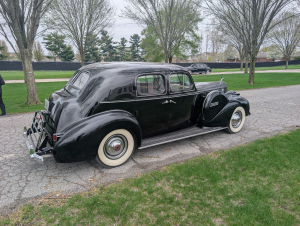
1940 Packard 180 donated to the Packard Motor Car Foundation by Wes’s father, Charles Blackman.
Seeing the Proving Grounds Differently
An urban planner by profession, Wes has spent his career thinking about places—how they’re designed, how communities grow around them, and how the past can remain part of their future. It’s perhaps no surprise, then, that his appreciation for the Proving Grounds extends well beyond Packard automobiles.
“I’m interested in the historic preservation angle of this,” he said, “the adaptive reuse of the property in order to make it enjoyed by a broader swath of people and to help preserve it.”
To Wes, the Albert Kahn-designed buildings, slate roofs, landscape, and history contained within the campus aren’t simply remnants of another era. Together, they create a place unlike anything surrounding it—and one that can continue to serve its community without sacrificing the character that makes it special.
That balance between preservation and use matters to him. He points to improvements that have made the historic buildings safer and more comfortable for visitors as examples of good physical stewardship. Protecting the Proving Grounds, in his view, also means allowing people to come through its gates, spend time there, and understand why it was worth saving in the first place.
His profession has also shaped the way he sees the world beyond those gates. Wes talks about the automobile not only as a machine, but as a force that helped shape Detroit’s economy and the communities surrounding it. He sees that story written into places like Van Dyke Avenue and the development that grew along it. Against that changing landscape, the Proving Grounds offers something increasingly rare: a tangible connection to the industry that helped shape the region.
Packard Beyond Michigan
Although Wes has lived in Florida since 1989, his distance from the Proving Grounds has given him another perspective on its future. He hopes to help nurture interest among Packard enthusiasts, historians, and supporters well beyond Michigan—people who may not live nearby, but can still become part of preserving and sharing its history.
“I’m unique in that I am not living in the shadow of the property,” he explained. His hope is to encourage a broader interest in the Proving Grounds, reaching those within the automobile hobby and beyond, regardless of geography.
Wes still returns to Michigan a couple of times each year and enjoys finding ways to contribute in person. He was particularly proud to help organize the Packard Salon, where he also experimented with 360-degree video—combining his appreciation for the history of the event with an interest in new ways of documenting and sharing it.
Life Beyond Packard
Away from Packard, another longtime passion occupies Wes’s time: music. He has played the euphonium since middle school and, after a 25-year hiatus, found himself staring at the instrument on the shelf during the pandemic and deciding it was finally time to play again. Today, he performs with the Symphonic Band of the Palm Beaches.
And then there are the advantages of Florida living.
“I try and take advantage of the fact that I can be in a public pool at 10 o’clock in the morning in February and think about all my friends in Michigan,” he joked. “I’m sitting in 80-degree water.”
If he could drive a Packard to the pool, he added, “even better.”
Making a Hidden Gem Less Hidden
For all the ways Wes thinks about the Proving Grounds—through Packard history, his father’s legacy, his profession, and its possibilities for the future—one of his simplest observations may say the most about what draws him to it.
When you’re there, he says, take a moment.
Look at the buildings. Notice the slate roofs. Pay attention to the architecture and how different the historic campus feels from everything that has grown up around it.
“Take a moment and drink in the architecture,” Wes said.
It’s something he’s had the unusual opportunity to do across more than five decades. Wes knew this place when the test track was still intact and cornfields stretched beyond its boundaries. Today, the landscape around it looks very different, but the historic buildings he remembers are still here—and now he’s among those helping consider what comes next.
During his interview, the Packard Proving Grounds was described as a hidden gem.
Wes quickly added one thought of his own:
“Our job in many ways is to make it not hidden.”
More than fifty years after first experiencing the Proving Grounds alongside his father, Wes still sees something here worth stopping to appreciate. And now, he’s helping make sure more people have the opportunity to see it, too.
