

Maeterlinck’s 1938 Packard Twelve 1607
Our 1938 Packard Twelve 1607 Club Sedan was not only one of the most prestigious American automobiles of its day, it was exported new to France for the family of Maurice Maeterlinck, the 1911 Nobel Prize–winning dramatist, poet, and essayist.
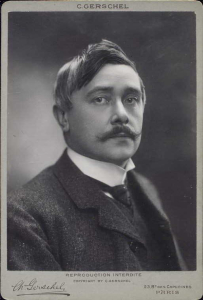
Maurice Maeterlinck
Born in Belgium in 1862, Maeterlinck became renowned for his deeply symbolic works exploring the mysteries of human existence. Among younger audiences, he is best remembered for The Blue Bird (1908), a play imbued with fairy-tale qualities. His other notable works include The Intruder (1890), The Blind (1890), and Interior (1895). In recognition of his literary achievements, he was made a Count by King Albert I of Belgium.
Maeterlinck’s later years were marked by upheaval. At the age of 78, as Nazi forces advanced across Europe, he fled persecution with his wife, Renée, and friends Joseph and Rose Pauline Dahon aboard the Greek liner Nea Hellas.
They arrived in New York on July 12, 1940, intending to stay at the Hotel Esplanade on Park Avenue. The Nazis seized the funds he had left in a Belgian bank, and he later claimed that the war had left him virtually penniless. After a brief stay in New York, he and his wife relocated to Florida. In 1945, they returned to Orlamonde, their estate in the south of France, though Maeterlinck remained largely removed from theatrical life, and his later plays were seldom performed. In 1947, he and Renée settled in Nice, where he died on May 6, 1949.
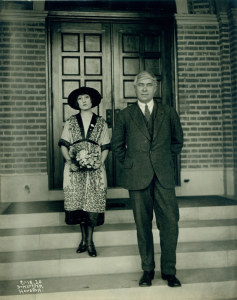
Mr. and Mrs. Maurice Materlinck, Rice Institute
The Packard remained with the Maeterlinck family until October 1989, when it was sold to respected European collectors Josep and Salvador Vilanova. In 2003, the car received a FIVA (Fédération Internationale des Véhicules Anciens) Identity Card, numbered 022177, recognizing its authenticity and historical significance.
In 2015, the car returned to the United States in excellent condition, showing 65,000 miles. It was purchased by Don Ghareeb of Alabama, one of the founders of Tacala Companies, which operates 340 franchised Taco Bell restaurants across the Southeast and Texas. Demonstrating remarkable generosity, Donald Ghareeb donated this mint-condition Packard.
The 1938 Packard Twelve 1607 Club Sedan represents the sixteenth series of Packard automobiles and marked the seventh year of the company’s second twelve-cylinder endeavor. By the following year, 1939, production of Packard’s famed V-12 would come to an end, closing a distinguished chapter in American automotive engineering.
In 1938, Packard introduced several notable chassis refinements over the 1937 model. Most significantly, the car now featured independent front suspension, improving ride quality and handling. The wheelbase was shortened from 139 inches to 134⅜ inches, giving the car a slightly more compact stance while maintaining its commanding presence. The styling also evolved: its fenders adopted a graceful pontoon design with a subtle upward sweep at the trailing edge behind the side-mounted spare tire. Another distinctive feature was the split “V” windscreen with a central chromed molding—the first time such a design appeared on a Packard.
Only 566 Packard Twelves were built for the 1938 model year. When introduced in September 1937, the Club Sedan was considered to be among the most prestigious American automobiles of its day. Unlike many large luxury cars intended for chauffeur-driven service, this short-wheelbase sedan was designed for the owner who preferred to sit behind the wheel.
This masterpiece of Packard engineering and tangible link to the extraordinary literary life of Maurice Maeterlinck will be placed on loan with the Classic Car Club of America Museum in Hickory Corners, Michigan, this year.
Editor’s Note:
Beginning April 10, the 1938 Packard Twelve 1607 will be featured in a new exhibition at the Classic Car Club of America Museum titled Hidden Treasures – Classics Preserved in the Shadows of War. The exhibit tells the remarkable stories of three Full Classics that were intentionally concealed across Europe during World War II to prevent their seizure by invading forces. The Packard—once hidden at an estate in France—will be displayed alongside a 1939 Buick and a 1931 Duesenberg, with immersive environments recreating the spaces where these automobiles were protected and preserved during the war.
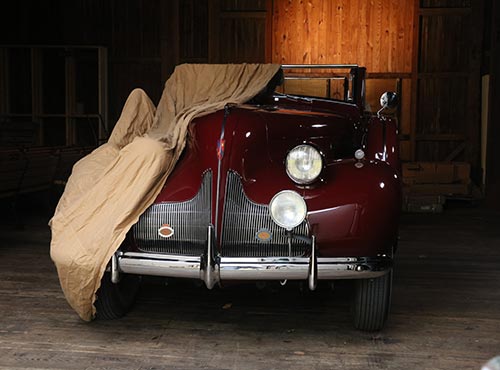
Photo courtesy of CCCA
